Enrichment for Teething Puppies: Safe Ways to Soothe Chewing, Biting, and Boredom
If your puppy is chewing the furniture, biting your hands, stealing socks, or suddenly acting like your baseboards are a snack, you are probably dealing with the teething stage.
It can feel frustrating, but your puppy is not trying to be “bad.” Teething puppies chew because their mouth feels uncomfortable, their brain is busy exploring the world, and they have not learned what is okay to bite yet.
That is where enrichment for teething puppies can help.
The goal is not to stop your puppy from chewing completely. Puppies need to chew. The goal is to give them safe, satisfying ways to chew, lick, sniff, and think so they are less likely to choose your shoes, couch, hands, or furniture legs.
In this guide, we will walk through safe teething puppy enrichment ideas, frozen treats, lick mats, chew toys, simple brain games, and a realistic plan for redirecting chewing before your puppy turns into a tiny land shark.
Quick Answer: What Is the Best Enrichment for Teething Puppies?
The best enrichment for teething puppies includes soft puppy-safe chew toys, frozen rubber toys, frozen lick mats, safe edible chews, sniffing games, and short training games. These activities can help soothe sore gums, redirect chewing, reduce boredom, and support calmer behaviour. Always supervise new toys and choose options based on your puppy’s size, age, and chewing style.Teething is one stage where enrichment can make daily life much easier. For more simple ways to keep your puppy busy, calm, and mentally stimulated, read our full guide to enrichment for puppies.
Why Teething Puppies Chew So Much
Chewing is normal puppy behaviour. Puppies use their mouths to explore, play, relieve discomfort, and interact with the world around them.
During teething, chewing can become more intense because your puppy’s gums may feel sore as baby teeth loosen and adult teeth come in.
Your puppy may chew because they are:
- Soothing sore gums
- Exploring new textures
- Bored and looking for something to do
- Overtired and unable to settle
- Seeking attention
- Practicing normal puppy play
- Trying to relieve stress or frustration
- Learning what is fun to bite
This is why simply saying “no” usually does not work.
Your puppy still needs an outlet. If you remove the shoe, they need something better to chew. If you stop the hand biting, they need a toy, nap, or calmer activity. If you block the furniture, they need a safe space where good choices are easier.
That is what puppy enrichment does. It gives your puppy appropriate ways to use their mouth, body, nose, and brain.
For more general ideas beyond teething, visit our full guide to enrichment for puppies.
When Does Puppy Teething Usually Happen?
Puppy teething often becomes noticeable around 3 to 4 months old, when baby teeth begin falling out and adult teeth start coming in. Many puppies have most of their adult teeth by around 6 months old, but every puppy is a little different.
A simple teething timeline looks like this:
| Puppy Age | What You May Notice |
|---|---|
| 8–12 weeks | Sharp baby teeth, lots of mouthing, exploring everything |
| 3–4 months | More chewing, possible loose teeth, increased biting |
| 4–6 months | Often the most intense teething stage |
| 6+ months | Adult teeth coming in, but chewing habits may continue |
Even after teething ends, chewing does not disappear. Chewing is still a normal dog behaviour. That is why this stage is such a good time to teach your puppy what they are allowed to chew.
The Teething Triangle: Discomfort, Boredom, and Access
When a teething puppy is chewing everything, there are usually three things happening at once:
- Discomfort — Their mouth feels weird or sore.
- Boredom — They need something to do.
- Access — They can reach things you do not want them to chew.
This is the part many puppy owners miss.
A chew toy helps with discomfort. A sniffing game helps with boredom. A baby gate or playpen helps with access.
If you only solve one part of the triangle, chewing usually continues.
For example, if your puppy has great chew toys but can still reach your shoes, your shoes may still win. If your puppy is bored all afternoon, they may chew the couch even if their gums are not bothering them. If your puppy is overtired, they may ignore every toy and bite your sleeves instead.
The best teething plan combines:
- Safe chewing
- Calming enrichment
- Puppy-proofing
- Redirection
- Rest
- Short training
- Supervision
You do not need a complicated system. You just need a few simple routines that make good choices easier for your puppy.
Best Enrichment for Teething Puppies
The best enrichment for a teething puppy gives them a safe job to do. It should be soothing, interesting, and appropriate for their age.
Here are the main types of teething enrichment that work well.
1. Chewing Enrichment
Chewing is the obvious one, but not all chews are equal.
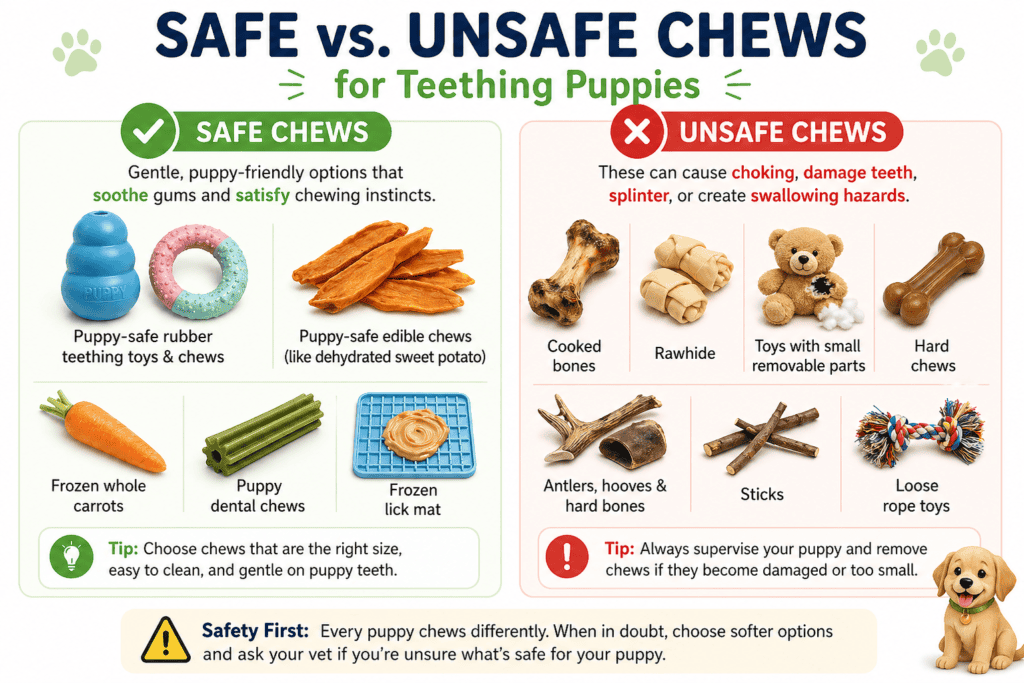
For teething puppies, look for softer puppy-safe options. Young teeth and gums need gentle choices, not rock-hard chews made for adult power chewers.
Good options may include:
- Soft rubber puppy chew toys
- Puppy teething rings
- Freezer-safe puppy toys
- Stuffable rubber toys
- Puppy-safe edible chews
- Textured toys made for teething puppies
Chewing enrichment is helpful when your puppy is trying to bite hands, furniture, chair legs, shoes, or blankets.
The key is to offer the chew before your puppy is already making a bad choice. If your puppy usually gets wild after dinner, give them a safe chew before they start biting your ankles.
2. Licking Enrichment
Licking can be very calming for many puppies. A lick mat, slow feeder, or stuffed toy gives your puppy something gentle and repetitive to focus on.
This can be especially helpful when your puppy is:
- Overexcited
- Struggling to settle
- Biting during quiet time
- Restless in the evening
- Needing a calm activity after play
Good lick mat toppings for puppies may include:
- Soaked and mashed kibble
- Wet puppy food
- Plain pumpkin
- Mashed banana
- Plain unsweetened yogurt, if your puppy tolerates dairy
- A small amount of xylitol-free peanut butter
Keep the layer thin. Puppies have sensitive stomachs, and too much rich food can cause digestive upset.
3. Frozen Enrichment
Frozen enrichment can feel soothing on sore gums and usually lasts longer than fresh food.
You can freeze:
- Stuffed puppy toys
- Lick mats
- Soaked kibble
- Puppy-safe broth in small amounts
- Wet puppy food
- Carrot sticks
- Soft rubber teething toys
- A damp washcloth, only for puppies who do not shred or eat fabric
Frozen activities are great when your puppy is chewing everything and needs a longer-lasting outlet.
4. Sniffing Enrichment
Not every teething activity has to involve chewing.
Sniffing is one of the easiest ways to tire out your puppy’s brain without making them more hyper. It is also helpful when your puppy has already had enough chewing but still seems restless.
Try:
- A snuffle mat
- Kibble scattered in a safe area
- Treats hidden under a towel
- A simple “find it” game
- A slow sniffy walk
- Kibble hidden in a muffin tin with toys on top
Sniffing games are especially helpful for puppies who get mouthy when they are bored.
5. Gentle Training Games
Short training games can redirect your puppy’s brain and mouth.
Keep sessions short. For a young puppy, 1 to 3 minutes can be enough.
Good skills to practice include:
- Sit
- Touch
- Drop it
- Leave it
- Trade
- Go to mat
- Find it
- Name recognition
Training is not just about obedience. It gives your puppy a way to earn rewards, use their brain, and learn what you want them to do instead.
Frozen Treats for Teething Puppies
Frozen treats are one of the easiest ways to help a teething puppy. They can soothe sore gums, keep your puppy busy, and give you a few peaceful minutes when you need to make coffee, answer an email, or just breathe.
Here are some simple options.
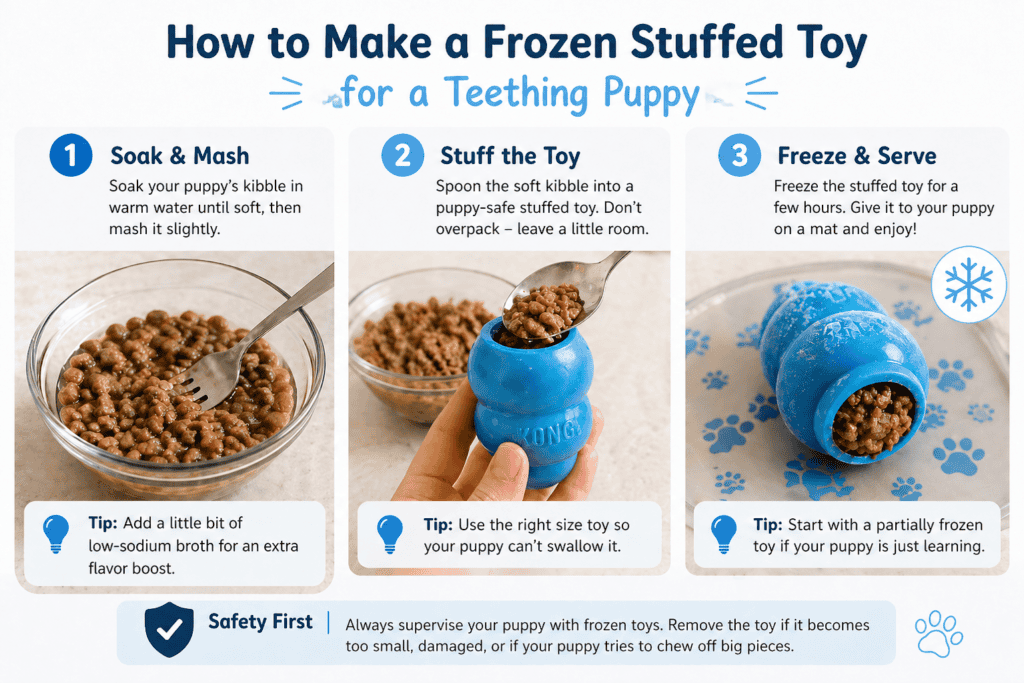
Frozen Stuffed Puppy Toy
What You Need
- A puppy-safe stuffable rubber toy
- Your puppy’s kibble
- Water or dog-safe broth
- Optional small spoonful of wet puppy food
How to Make It
- Soak your puppy’s kibble in warm water until soft.
- Mash it lightly with a fork.
- Spoon it into the toy.
- Freeze for a few hours.
- Give it to your puppy on a washable mat or towel.
Make It Easier
Do not freeze it fully the first time. A chilled or partially frozen toy is easier for beginners.
Make It Harder
Pack the food more tightly or freeze it in layers.
Safety Tip
Choose a toy that is large enough that your puppy cannot swallow it. Watch your puppy the first few times to make sure they lick and chew safely.
Best For
Puppies who need a longer-lasting activity or who chew furniture when bored.
Frozen Lick Mat
What You Need
- A puppy-safe lick mat
- Wet puppy food, soaked kibble, plain pumpkin, or mashed banana
- Freezer space
How to Make It
- Spread a thin layer of food across the mat.
- Freeze it for 1 to 3 hours.
- Place it on the floor in a calm area.
- Supervise your puppy while they lick.
- Pick it up when they are finished.
Make It Easier
Use soft food and serve it chilled instead of fully frozen.
Make It Harder
Freeze it longer or press a few pieces of kibble into the food.
Safety Tip
Remove the mat if your puppy starts chewing it instead of licking it.
Best For
Puppies who need help calming down after play or before nap time.
Frozen Carrot Stick
What You Need
- A washed and peeled carrot
- Freezer space
How to Make It
- Wash and peel the carrot.
- Cut it into a safe size for your puppy.
- Freeze it.
- Offer it while supervised.
Make It Easier
Use a thinner carrot piece or chill it instead of freezing it solid.
Make It Harder
For larger puppies, use a bigger piece that is harder to finish quickly.
Safety Tip
Take it away if your puppy breaks off large chunks or tries to swallow pieces whole.
Best For
Puppies who enjoy crunchy textures.
Frozen Washcloth Twist
This can be helpful for gentle chewers, but it is not right for every puppy.
What You Need
- A clean washcloth
- Water
- Freezer
How to Make It
- Wet the washcloth.
- Twist it into a rope shape.
- Freeze it.
- Offer it while supervised.
Make It Easier
Chill it instead of freezing it solid.
Make It Harder
Tie one loose knot in the middle.
Safety Tip
Skip this activity if your puppy shreds fabric, pulls threads, or tries to eat cloth.
Best For
Gentle puppies who like soft textures and do not destroy fabric.
How to Use a Frozen Lick Mat Safely
A frozen lick mat can be one of the best calming tools for a teething puppy, but it works best when used the right way.
The biggest mistake is loading it with too much food. A lick mat does not need to be thickly covered. A thin layer is enough, especially for puppies.
Puppy-Safe Lick Mat Ideas
Try one of these simple combinations:
- Soaked kibble + water
- Wet puppy food + a few pieces of kibble
- Plain pumpkin + mashed banana
- Plain yogurt + crushed kibble
- Tiny amount of xylitol-free peanut butter + soaked kibble
Always check ingredient labels. Peanut butter must be xylitol-free. Xylitol is unsafe for dogs.
When to Use a Lick Mat
A lick mat can be useful:
- After a potty break
- Before nap time
- During grooming practice
- After a walk
- When your puppy is mouthy but not truly hungry
- When you need a calm activity in the playpen
When Not to Use a Lick Mat
Skip the lick mat if your puppy:
- Chews and destroys the mat
- Guards food
- Gets frustrated
- Has an upset stomach from toppings
- Needs a potty break instead
- Is overtired and really needs sleep
A lick mat is a tool, not a magic fix. If your puppy is wildly overtired, the best enrichment may be a potty break and a nap.
Safe Chews for Teething Puppies

Choosing safe chews for teething puppies can feel confusing because there are so many options.
A good puppy chew should be interesting enough to redirect chewing, but gentle enough for young teeth and gums.
What to Look For
Choose chews that are:
- Made for puppies
- The right size for your puppy’s mouth
- Too large to swallow whole
- Slightly flexible or gentle
- Easy to clean
- Durable enough for your puppy’s chewing style
- Free from small parts
- Not likely to splinter
What to Avoid
Be careful with:
- Cooked bones
- Very hard bones
- Antlers
- Chews that splinter
- Toys with small removable pieces
- Toys that are too small
- Fabric toys your puppy rips and eats
- Anything your puppy tries to gulp
- Chews that cause vomiting or diarrhea
A simple test many owners use is the “thumbnail test.” If you cannot make any mark on the chew with your thumbnail, it may be too hard for a young puppy. This is not a perfect rule, but it can help you think twice before offering very hard chews.
When in doubt, ask your vet what chews are safe for your puppy’s age, breed, size, and teeth.
What to Do When Your Puppy Bites Your Hands
Puppy biting during teething is common, but it still needs gentle guidance.
Your puppy needs to learn: toys are for biting, hands are not.
What to Do in the Moment
Use this simple redirection plan:
- Stay calm.
- Stop waving your hands around.
- Offer a toy, chew, or tug toy.
- Make the toy more interesting by moving it slowly along the floor.
- Praise your puppy when they bite the toy.
- If they keep biting you, calmly step behind a baby gate or end play for a short moment.
The goal is not to punish your puppy. The goal is to make biting you boring and biting the toy rewarding.
What Not to Do
Try not to:
- Yell
- Hit
- Grab your puppy’s muzzle
- Push your puppy away roughly
- Wave your hands around
- Chase your puppy
- Turn stolen items into a game
Big reactions can make biting more exciting.
What Your Puppy May Actually Need
If redirection is not working, your puppy may need something else.
They may need:
- A nap
- A potty break
- Food
- Water
- A calmer room
- Less rough play
- A better chew
- A short sniffing game
- A playpen reset
Many puppies bite the most when they are overtired. If your puppy gets wild every evening, they may not need more play. They may need help settling.
Teething Puppy Activities You Can Try Today
These activities are simple, beginner-friendly, and easy to set up at home.
1. The Chew Toy Rotation
This is one of the easiest ways to make old toys feel new again.
What You Need
- 6 to 10 puppy-safe toys
- A basket or bin
How to Do It
- Choose 2 or 3 toys to leave out.
- Put the rest away.
- Rotate toys every day or two.
- Bring out a different toy when your puppy starts chewing the wrong thing.
Make It Easier
Start with only one or two toys available at a time.
Make It Harder
Add one special toy that only comes out during calm chew time.
Safety Tip
Check toys daily for damage and remove anything broken.
Best For
Puppies who get bored of toys quickly.
2. The “Find It” Game
This is a great game for puppies who need something to do but are getting too mouthy.
What You Need
- Kibble or tiny treats
- A safe room or puppy-proof area
How to Do It
- Hold a piece of kibble near your puppy’s nose.
- Say “find it.”
- Toss it a short distance.
- Let your puppy sniff it out.
- Repeat 5 to 10 times.
Make It Easier
Place the food where your puppy can see it.
Make It Harder
Hide the food behind a toy or under the edge of a towel.
Safety Tip
Do not hide treats near cords, furniture legs, rugs, or anything your puppy may chew.
Best For
Puppies who bite when they are bored or restless.
3. The Towel Roll-Up
This gives your puppy a simple sniffing puzzle.
What You Need
- A towel
- Kibble
How to Do It
- Lay the towel flat.
- Sprinkle kibble across it.
- Roll it loosely.
- Let your puppy push and sniff to unroll it.
Make It Easier
Roll the towel very loosely.
Make It Harder
Fold the towel once before rolling it.
Safety Tip
Skip this if your puppy eats fabric.
Best For
Puppies who enjoy sniffing and gentle problem-solving.
4. Calm Chew Station
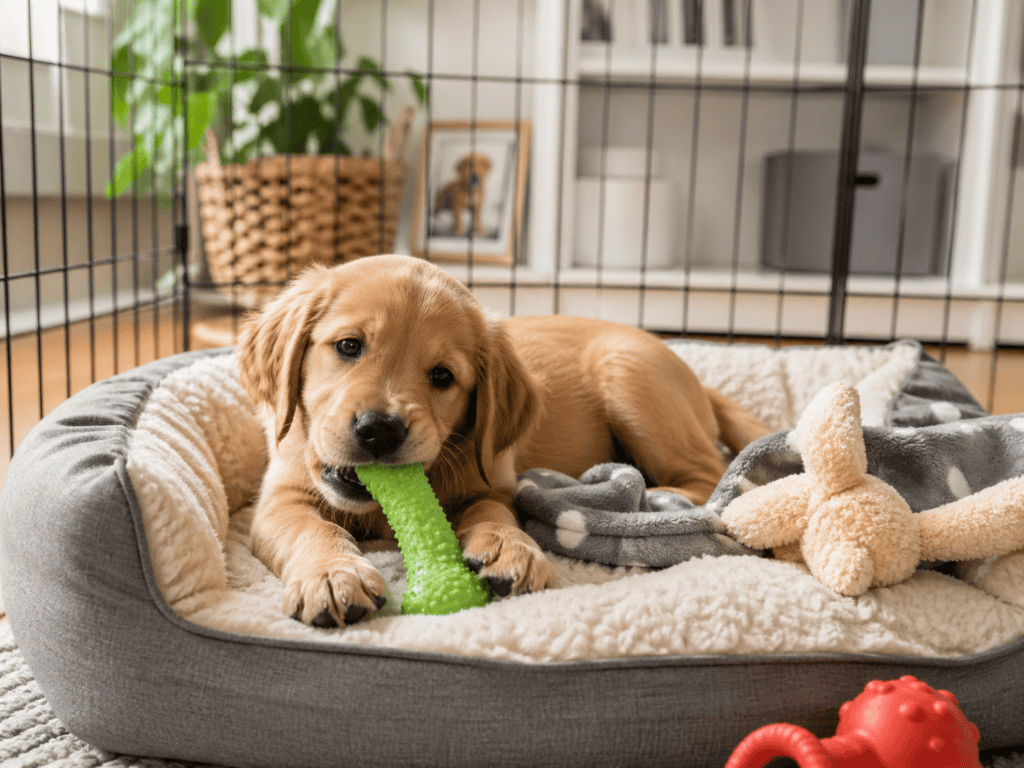
A calm chew station teaches your puppy that chewing can happen in a relaxing place.
What You Need
- A puppy bed, crate, or playpen
- A safe chew or frozen toy
- Water nearby
- A quiet area
How to Do It
- Take your puppy potty first.
- Place them in their calm area.
- Offer a safe chew or frozen toy.
- Keep the room quiet.
- Remove the chew when it becomes too small or damaged.
Make It Easier
Stay nearby at first so your puppy does not feel isolated.
Make It Harder
Use this routine during slightly busier household times.
Safety Tip
Do not leave high-value chews unattended unless you know your puppy can handle them safely.
Best For
Puppies who struggle to settle in the evening.
5. Trade Game
This is helpful for puppies who steal socks, paper, or household items.
What You Need
- A safe toy
- Treats or kibble
How to Do It
- Give your puppy a toy.
- Offer a treat near their nose.
- When they drop the toy, say “trade.”
- Give the treat.
- Return the toy if it is safe.
Make It Easier
Practice with boring toys first.
Make It Harder
Practice with slightly more exciting toys.
Safety Tip
Do not practice with dangerous stolen items. If your puppy has something unsafe, calmly remove it and manage the environment better next time.
Best For
Puppies who run away with stolen items.
A Simple Daily Teething Enrichment Routine
You do not need to entertain your puppy every minute of the day. In fact, too much activity can make puppies more frantic.
A simple teething routine might look like this:
Morning
- Potty break
- Breakfast in a slow feeder or puzzle toy
- Short training game
- Nap
Midday
- Potty break
- Sniffing game or short walk
- Safe chew in a playpen
- Nap
Afternoon
- Frozen stuffed toy
- Gentle play
- Potty break
- Nap
Evening
- Dinner
- Calm chewing activity
- Lick mat or frozen toy
- Quiet time
- Bedtime routine
The exact routine does not matter. What matters is the rhythm: potty, food, play, enrichment, rest.
If your puppy is chewing everything, ask yourself: “Do they need chewing, sniffing, training, management, or sleep?”
That question alone can make the teething stage feel much easier.
Safety Tips for Teething Puppy Enrichment
Teething enrichment should feel helpful, not stressful. A few simple safety habits can prevent most problems.
- Supervise your puppy with new toys, chews, and frozen activities.
- Choose toys based on your puppy’s size, age, and chewing style.
- Remove broken toys, loose stuffing, and small pieces.
- Avoid chews that are too hard for puppy teeth.
- Do not give cooked bones.
- Avoid toys your puppy can swallow.
- Use puppy-safe foods only.
- Check peanut butter labels for xylitol.
- Keep rich toppings small.
- Skip cardboard, towels, or paper games if your puppy eats them.
- Wash lick mats, slow feeders, and food toys after use.
- Ask your vet if you are unsure about chews, food, diet, or dental concerns.
Also watch your puppy’s body language. If they seem frustrated, frantic, possessive, or overly tired, the activity may not be the right fit in that moment.
Common Mistakes Puppy Owners Make
Mistake 1: Giving Too Many Toys at Once
If every toy is always available, toys become boring. Keep a few out and rotate the rest.
Mistake 2: Waiting Until the Puppy Is Already Wild
Enrichment works best before chaos starts. If your puppy gets mouthy every night at 7 p.m., offer a frozen chew at 6:45 p.m.
Mistake 3: Using Chews That Are Too Hard
Hard chews can be risky for young teeth. Choose puppy-safe options and ask your vet if you are not sure.
Mistake 4: Accidentally Making Stolen Items Fun
If your puppy steals a sock and you chase them, they may learn that stealing socks starts a fun game. Use a calm trade instead.
Mistake 5: Forgetting About Sleep
Puppies need a lot of rest. Sometimes biting and chewing get worse because your puppy is overtired, not because they need more excitement.
Mistake 6: Using Food Enrichment Without Counting the Food
If you use lots of treats, lick mats, and stuffed toys, your puppy may end up eating more than you realize. Use part of their regular meals for enrichment when possible.
Troubleshooting: What If Nothing Works?
My puppy finishes frozen treats too fast.
Try soaking kibble and packing it into a stuffable toy before freezing. You can also freeze in layers so the toy lasts longer.
My puppy chews the lick mat.
Pick it up right away. Try a sturdier frozen rubber toy instead.
My puppy keeps biting me instead of the toy.
The toy may not be exciting enough, or your puppy may be overtired. Try moving the toy along the floor, offering a chew, playing “find it,” or putting your puppy down for a nap.
My puppy is chewing furniture.
Block access first. Use baby gates, a playpen, or close supervision. Then offer a safe chew before your puppy reaches the furniture.
My puppy eats cardboard, towels, or fabric.
Skip DIY cardboard and fabric games. Use rubber toys, slow feeders, lick mats, or supervised sniffing games instead.
My puppy guards chews or frozen toys.
Stop using high-value items for now and speak with a qualified trainer. Resource guarding is easier to work on early with the right support.
My puppy seems painful or is not eating normally.
Call your vet. Mild teething discomfort can be normal, but obvious pain, swelling, broken teeth, strong mouth odor, or trouble eating should be checked.
Product Guide: What to Look For
This topic naturally works well for helpful product recommendations, but you do not need to buy everything.
A small teething toolkit is usually enough.
Helpful Products for Teething Puppies
- Puppy teething toys
- Freezer-safe rubber toys
- Lick mats
- Slow feeders
- Snuffle mats
- Puppy-safe edible chews
- Silicone freezer molds
- Washable feeding mats
- Baby gates or playpens
What to Look For in Puppy Teething Toys
Choose toys that are:
- Made for puppies
- Easy to clean
- Not too hard
- Not too small
- Freezer-safe, if you want cold relief
- Durable enough for your puppy
- Comfortable for your puppy to hold and chew
What to Look For in a Lick Mat
A good puppy lick mat should be:
- Easy to wash
- Made from pet-safe material
- Not too flimsy
- The right size for your puppy
- Simple enough for a beginner puppy
- Used only with supervision if your puppy likes to chew
What to Look For in a Snuffle Mat
Choose a snuffle mat that is:
- Washable
- Not too complicated
- Large enough for your puppy to use comfortably
- Sturdy enough for light pawing and sniffing
- Easy to put away when not in use
When a DIY Option Is Enough
You may not need to buy a puzzle toy right away. A towel roll-up, scattered kibble, or simple find-it game can work very well for beginners.
When Buying a Product May Help
Buying a few enrichment tools may be worth it if:
- Your puppy gets bored quickly
- You work from home
- Your puppy chews furniture
- You need safe playpen activities
- You want longer-lasting frozen options
- DIY activities are getting destroyed
Start with the basics. You can always add more later.
More Enrichment for Puppies
Teething is just one part of puppy enrichment. For more ideas on keeping your puppy busy, calm, and happy through every stage, read our full guide to enrichment for puppies.
Conclusion
Teething can be a messy, bitey, frustrating stage, but it is also a great time to teach your puppy what to chew, how to settle, and how to use their brain in healthy ways.
The best enrichment for teething puppies is not one magic toy. It is a mix of safe chewing, frozen treats, licking, sniffing, gentle training, rest, and smart management.
If your puppy is chewing everything, start simple. Puppy-proof the area, rotate a few safe toys, offer frozen enrichment before the usual biting time, and use calm redirection when they make the wrong choice.
Your puppy is learning. With patience, supervision, and the right enrichment, this stage can become much more manageable.
FAQ: Enrichment for Teething Puppies
What is the best enrichment for teething puppies?
The best enrichment for teething puppies includes puppy-safe chew toys, frozen stuffed toys, frozen lick mats, safe edible chews, sniffing games, and short training games. These activities help soothe sore gums and redirect chewing.
Are frozen treats good for teething puppies?
Frozen treats can be helpful for teething puppies because the cold texture may soothe sore gums and keep them busy. Use puppy-safe ingredients, keep portions small, and supervise your puppy while they chew or lick.
Can I give my puppy a frozen lick mat?
Yes, many puppies enjoy frozen lick mats. Use a thin layer of wet puppy food, soaked kibble, plain pumpkin, mashed banana, or another puppy-safe topping. Remove the mat if your puppy starts chewing it.
What can I give my puppy instead of my hands?
Offer a soft puppy teething toy, frozen rubber toy, safe chew, or tug toy. If your puppy keeps biting your hands, calmly pause play and redirect them to something appropriate to bite.
Why is my teething puppy chewing furniture?
Your puppy may be chewing furniture because their gums are sore, they are bored, they are overtired, or the furniture is easy to access. Block access, offer safe chews, and give your puppy more appropriate enrichment.
Are ice cubes safe for teething puppies?
Some puppies may enjoy ice cubes, but they should be offered carefully and supervised. A safer option for many puppies is a frozen puppy toy, frozen stuffed toy, or chilled chew designed for puppies.
How long does puppy teething last?
Puppy teething often starts around 3 to 4 months and many puppies have most of their adult teeth by around 6 months. Chewing may continue after teething because chewing is also normal dog behaviour.
When should I ask a vet about puppy teething?
Ask your vet if your puppy has heavy bleeding, swelling, broken teeth, strong mouth odor, trouble eating, or signs of serious pain. You should also ask your vet if you are unsure which chews are safe.